
Introduction
Data communication plays an important role in modern embedded systems by enabling devices to exchange information with remote servers over the Internet. GPRS (General Packet Radio Service) technology provides an economical and reliable method for transmitting data from a microcontroller to a web server through a GSM network. This project demonstrates how sensor or device data can be collected, processed, and uploaded to a remote server for real-time monitoring and analysis.
Abstract :
The Data Transferring from Microcontroller to Server Using GPRS Communication system enables real-time transmission of sensor data from a microcontroller to a remote web server using GPRS technology. The system establishes internet connectivity through a GSM/GPRS modem and transfers data using HTTP or TCP/IP protocols. It is widely used in industrial automation, remote monitoring, smart agriculture, and IoT applications.
GPRS Communication Overview
General Packet Radio Service (GPRS) is a wireless packet-switching technology that provides internet connectivity over GSM networks. It enables embedded devices to send and receive data continuously without requiring a dedicated communication channel. GPRS communication is commonly used for remote monitoring, web-based data logging, asset tracking, and industrial automation due to its wide network coverage and low communication cost.
System Architecture
The system consists of a microcontroller, GPRS modem, sensors, web server, database, and user interface. The microcontroller collects sensor data and communicates with the GPRS modem using UART serial communication. The modem establishes a GPRS connection with the GSM network and transfers the collected data to the web server through HTTP or TCP/IP protocols. The server stores the information in a database, allowing users to access real-time data through a web application.
Technical Specifications
Hardware Specifications
| Component | Specification |
|---|---|
| Microcontroller | AT89S52 |
| GSM/GPRS Modem | SIM300 / SIM900 |
| Crystal Oscillator | 11.0592 MHz |
| Voltage Regulator | 7805 |
| Power Supply | 12V DC |
| LCD Display | 16×2 LCD (Optional) |
Software Specifications
- Keil IDE
- Proteus VSM
- Embedded C
- UC Flash
Hardware Components
- AT89S52 Microcontroller
- GSM/GPRS Modem
- MAX232 IC
- 16×2 LCD Display
- 7805 Voltage Regulator
- Crystal Oscillator
- Power Supply
- Capacitors
- Resistors
- Connecting Wires
BLOCK DIAGRAM :
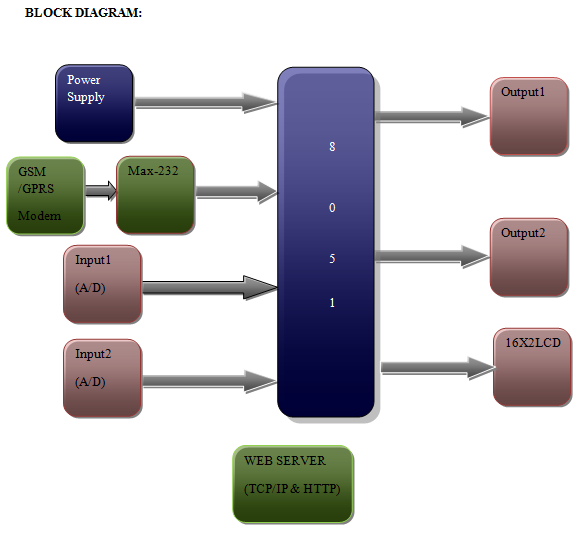
Block Diagram Explanation
The microcontroller collects data from connected sensors and sends it to the GPRS modem through UART serial communication. The GPRS modem establishes an internet connection using the GSM network and transfers the data to the remote web server. The server receives the information, stores it in a database, and makes it available for monitoring through a web-based dashboard.
Working Principle
The system continuously collects sensor or device data through the microcontroller. The collected information is formatted into a suitable data packet and transmitted to the GPRS modem using serial communication. The modem establishes a connection with the remote web server through the GSM network and uploads the data using HTTP or TCP/IP protocols. The server processes and stores the received information, allowing users to monitor the system remotely.
Communication Process
The communication process begins with data acquisition by the microcontroller. After processing the data, the microcontroller sends AT commands to the GPRS modem to establish internet connectivity. The modem transmits the data packet to the remote server, where it is validated and stored in the database. The server then displays the information through a web application for real-time monitoring.
Server Data Processing
The web server receives incoming data packets from the GPRS modem and verifies the received information. Each data packet contains details such as device identification, sensor readings, date, time, and system status. After validation, the server stores the data in the database and updates the monitoring dashboard for user access.
Communication Protocol
The communication between the microcontroller and the GPRS modem is performed using UART serial communication. The GPRS modem communicates with the web server using HTTP or TCP/IP protocols. AT commands are used to configure the modem, establish internet connectivity, and transmit data successfully.
Applications
- Industrial Automation
- Smart Agriculture
- Weather Monitoring Systems
- Water Level Monitoring
- Vehicle Tracking Systems
- Remote Energy Meter Monitoring
- Environmental Monitoring
- Smart City Applications
- Asset Tracking
- IoT-Based Remote Monitoring
- Factory Automation
- Healthcare Monitoring Systems
Benefits
- Enables real-time data transmission.
- Supports remote monitoring through the internet.
- Reduces manual data collection.
- Improves operational efficiency.
- Reliable wireless communication.
- Easy integration with embedded systems.
- Suitable for industrial and IoT applications.
- Centralized data storage and monitoring.
Limitations
- Depends on GSM network coverage.
- Requires an active SIM card with a data plan.
- Communication speed is lower than modern 4G or 5G networks.
- Network interruptions may affect data transmission.
- Signal strength influences communication reliability.
Future Enhancements
The system can be upgraded by integrating LTE, NB-IoT, or 5G communication modules for higher-speed data transmission. Cloud computing, MQTT protocol, HTTPS communication, GPS integration, and mobile applications can further improve security, scalability, and remote monitoring capabilities.
Conclusion
The Data Transferring from Microcontroller to Server Using GPRS Communication project demonstrates an effective method for transmitting data from embedded systems to remote servers using wireless communication. By combining a microcontroller, GPRS modem, and web server, the system enables reliable real-time monitoring and centralized data management. It is suitable for industrial automation, smart agriculture, IoT applications, and remote monitoring systems.