
Biometric Security at a Glance
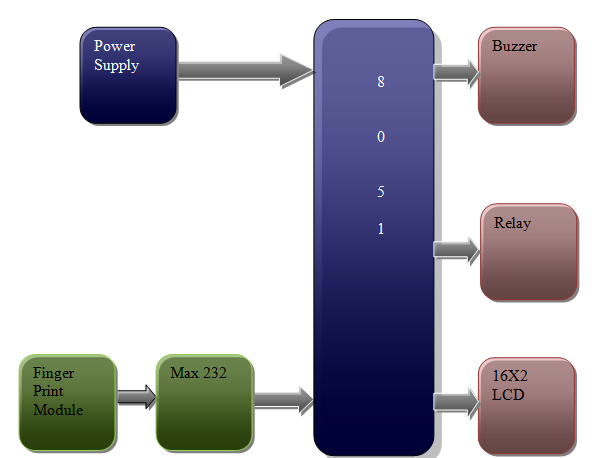
The Fingerprint- Based Authentication System is an embedded security project designed to identify authorized users through their fingerprints. Unlike passwords or access cards, fingerprint authentication uses a biometric characteristic associated with an individual.
In this project, fingerprint data is enrolled in the fingerprint module and assigned an identification number. During authentication, a newly scanned fingerprint is compared with the stored templates. Embedded fingerprint systems commonly combine a fingerprint sensor with a microcontroller and serial communication for enrollment and verification.
Authentication Sequence
The system follows two important stages: fingerprint enrollment and fingerprint verification.
During enrollment, the user’s fingerprint is captured and stored as a template. During verification, the user places a finger on the sensor again. The fingerprint module processes the scan and searches for a matching stored template.
When a valid match is identified, the microcontroller can display an authorized message and activate the connected output device. If the fingerprint is not recognized, access is rejected, and a buzzer can provide an alert.
Main Electronic Sections
The project can be constructed using the following sections:
- AT89S52 Microcontroller
- Fingerprint Sensor Module
- 16×2 LCD
- Buzzer
- Status LEDs
- Crystal Oscillator
- Regulated Power Supply
- Control Output Interface
- PCB and supporting components
Your existing project specifies an AT89S52 microcontroller, 11.0592 MHz crystal, HD44780-compatible LCD, biometric module, buzzer, GPIOs, and regulated power supply.
Fingerprint Enrollment Process
Before authentication can begin, authorized fingerprints must be registered.
The user places a finger on the biometric sensor, which captures fingerprint characteristics and creates a template. The template is then stored with a unique ID.
Multiple users can therefore be registered, depending on the storage capacity of the selected fingerprint module.
Identity Verification Process
Whenever a person requests access, the sensor captures the fingerprint and compares it with previously enrolled templates.
Match Found: The system recognizes the person as an authorized user and enables the required output.
No Match Found: The system identifies the attempt as unauthorized and can activate an audible or visual warning.
Communication Between Sensor and Controller
The fingerprint module communicates with the microcontroller through a serial communication interface such as UART. The controller sends commands to the biometric module and receives enrollment, search, matching, and identification results.
Your existing design specifically uses UART communication between the biometric module and the 8051-family microcontroller.
User Indication and Alerts
A 16×2 LCD provides information about the current authentication process. Depending on the program, messages can include:
Place Finger → Scanning → Fingerprint Matched → Access Granted
For an unsuccessful attempt:
Place Finger → Scanning → No Match → Access Denied
A buzzer and LED indicators can provide additional notification when an unauthorized fingerprint is detected.
Project Hardware Details
| Section | Specification |
|---|---|
| Microcontroller | AT89S52 |
| Controller Supply | 5V DC |
| Crystal Frequency | 11.0592 MHz |
| Display | 16×2 LCD |
| Biometric Input | Fingerprint Module |
| Communication | UART |
| Alert Device | Buzzer |
| Visual Indicator | LED |
| Regulation | 7805 / 7812 |
| Programming | Embedded C |
These specifications reflect the hardware described on your current project page.
Security Benefits
Fingerprint-based authentication provides several practical benefits:
- Eliminates the need to remember passwords
- Provides quick user identification
- Prevents simple sharing of access cards or PINs
- Supports multiple registered users
- Provides automatic access decisions
- Can be integrated with electronic locks
- Suitable for embedded security applications
- Provides a convenient user interface
Where This System Can Be Implemented
The project can be adapted for:
- Industrial entry control
- Office access systems
- Laboratory security
- Restricted rooms
- Employee authentication
- Attendance systems
- Electronic door locks
- Educational institutions
- Equipment authorization
- Embedded security demonstrations
Scope for Advanced Development
The basic system can be upgraded by integrating technologies such as GSM, Wi-Fi, ESP32, IoT platforms, RFID, cloud databases, or mobile applications.
Advanced versions can record the user ID and authentication time, send notifications after unauthorized attempts, maintain attendance records, or provide remote monitoring.
Skills Gained from the Project
Developing this project provides practical exposure to biometric technology, 8051 microcontrollers, UART communication, LCD interfacing, sensor integration, Embedded C programming, PCB design, and access-control logic.
It is therefore suitable as an academic project for students learning embedded systems and biometric security.
Project Summary
The Fingerprint- Based Authentication System provides a practical method for controlling access through biometric identification. By combining a fingerprint module with a microcontroller, LCD, buzzer, and control circuitry, the system can register users, verify fingerprints, and respond according to the authentication result.
The project demonstrates how biometric identification can be integrated with embedded hardware to build access-control and security applications.