
Inductor: Working Principle, Types, Applications, and Uses
Introduction
An inductor is a passive electronic component that stores electrical energy in the form of a magnetic field when electric current flows through it. It is commonly made by winding insulated wire into a coil around an air, iron, or ferrite core.
Inductors are widely used in electronic circuits, power supplies, filters, oscillators, transformers, and communication systems. They play an important role in controlling current changes and filtering unwanted electrical signals.
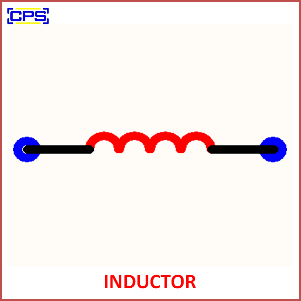
What Is an Inductor?
An inductor is a two-terminal passive component designed to resist sudden changes in current. The ability of an inductor to store energy is measured by its inductance, which is represented by the symbol L and measured in Henries (H).
The basic relationship between voltage and current in an ideal inductor is:
[
V = L\frac{di}{dt}
]
where:
- V = Voltage across the inductor
- L = Inductance
- di/dt = Rate of change of current
When current passes through the coil, a magnetic field is generated around it. The inductor stores energy in this magnetic field.
Working Principle of an Inductor
The working principle of an inductor is based on electromagnetic induction.
When current flows through the coil, it produces a magnetic field. If the current changes, the magnetic field also changes. This change produces an induced voltage that opposes the change in current.
This property is known as self-inductance.
An inductor therefore:
- Opposes sudden changes in current
- Stores energy in a magnetic field
- Releases stored energy when required
- Allows DC current to pass after the circuit reaches steady state
- Provides greater opposition to higher-frequency AC signals
Energy Stored in an Inductor
The energy stored in an ideal inductor can be expressed as:
[
E = \frac{1}{2}LI^2
]
where:
- E = Stored energy in joules
- L = Inductance in henries
- I = Current through the inductor in amperes
The amount of stored energy depends on both the inductance and the current flowing through the component.
Types of Inductors
Inductors are available in different forms depending on their construction and application.
1. Air-Core Inductor
An air-core inductor does not use a magnetic core. It is commonly used in high-frequency applications because it has relatively low core losses.
2. Iron-Core Inductor
An iron core is used to increase the inductance of the coil. Iron-core inductors are commonly used in low-frequency and power applications.
3. Ferrite-Core Inductor
Ferrite-core inductors use ferrite material to provide high magnetic permeability and are widely used in high-frequency electronic circuits and switching power supplies.
4. Toroidal Inductor
A toroidal inductor is wound around a ring-shaped magnetic core. Its design helps reduce electromagnetic interference and magnetic flux leakage.
5. SMD Inductor
Surface-mount inductors are compact components designed for PCB assembly. They are commonly used in smartphones, computers, communication devices, and compact electronic circuits.
6. Variable Inductor
A variable inductor allows the inductance value to be adjusted. These components are used in tuning and frequency-selection circuits.
Inductor Symbol
The standard circuit symbol for an inductor is represented by a series of curved loops or coils. The symbol is used in circuit diagrams to identify the component and its electrical connection.
Important Parameters of an Inductor
When selecting an inductor, several electrical parameters should be considered.
Inductance
Inductance determines the ability of the component to oppose changes in current. It is measured in henries (H).
Common values include:
- Microhenry (µH)
- Millihenry (mH)
- Henry (H)
Current Rating
The current rating indicates the maximum current that the inductor can safely carry without excessive heating or magnetic saturation.
DC Resistance
The winding of an inductor has electrical resistance. This resistance causes power loss when current flows through the component.
Saturation Current
When the magnetic core becomes saturated, the inductance can decrease significantly. Therefore, the saturation current is an important parameter in power applications.
Quality Factor
The Q factor indicates the efficiency of an inductor in AC applications. A higher Q factor generally indicates lower losses.
Applications of Inductors
Inductors are used in many electronic and electrical systems.
Power Supplies
Inductors are commonly used in buck, boost, and other switching converters to store and transfer energy.
Filters
Inductors are used with capacitors and resistors to create filters that reduce unwanted noise and electrical signals.
RF and Communication Circuits
High-frequency inductors are used in radio-frequency circuits, antennas, oscillators, and tuning networks.
EMI Filtering
Inductors and common-mode chokes can help reduce electromagnetic interference in electronic systems.
Oscillator Circuits
Inductors are combined with capacitors to form LC resonant circuits used for frequency generation and selection.
Transformers
Inductors are closely related to transformer operation, where magnetic coupling between coils enables energy transfer and voltage transformation.
Motor and Relay Circuits
Inductive components are found in motors, relays, solenoids, and other electromagnetic devices.
Advantages of Inductors
- Store energy in a magnetic field
- Resist rapid changes in current
- Useful for filtering electrical signals
- Available in many sizes and inductance values
- Suitable for power-management applications
- Useful in high-frequency and communication circuits
Limitations of Inductors
- Physical size can become large at higher inductance values
- Winding resistance causes power losses
- Magnetic cores can experience saturation
- May produce electromagnetic interference
- Performance can vary with frequency and temperature
Inductor vs Capacitor
Inductors and capacitors are both passive energy-storage components, but they store energy differently.
| Parameter | Inductor | Capacitor |
|---|---|---|
| Energy storage | Magnetic field | Electric field |
| Main property | Opposes change in current | Opposes change in voltage |
| Unit | Henry (H) | Farad (F) |
| Common applications | Filters, converters, RF circuits | Filtering, coupling, energy storage |
Conclusion
An inductor is an important passive component used in a wide range of electronic and electrical circuits. It stores energy in a magnetic field and opposes changes in current, making it particularly useful in power supplies, filters, communication circuits, oscillators, and EMI-control applications.
Understanding parameters such as inductance, current rating, DC resistance, saturation current, and Q factor is essential when selecting an inductor for a particular circuit. With the increasing use of compact and high-efficiency electronic systems, inductors continue to play an important role in modern electronics and embedded-system design.