
Abstract
The Weather Monitoring System in Remote Places Using GSM is an embedded systems project developed to monitor environmental conditions in remote locations where direct human supervision is difficult. The system collects weather parameters such as temperature, humidity, light intensity, and rainfall using electronic sensors. A microcontroller processes the sensor data and transmits the information to users through a GSM module using SMS or mobile communication. This solution enables real-time weather monitoring, supports timely decision-making, and is suitable for agriculture, environmental research, disaster management, and industrial monitoring. GSM connectivity provides long-distance communication without requiring a local Wi-Fi network, making it practical for remote deployments.
Why Remote Weather Monitoring is Important
Many agricultural fields, forests, mountains, construction sites, and industrial locations are situated far from cities and require continuous environmental monitoring. Manual weather observation is time-consuming and often impractical. A GSM-based weather monitoring system automatically collects weather information and sends it to users, helping them respond quickly to changing environmental conditions while reducing manual effort.
Working Principle of the GSM Weather Monitoring System
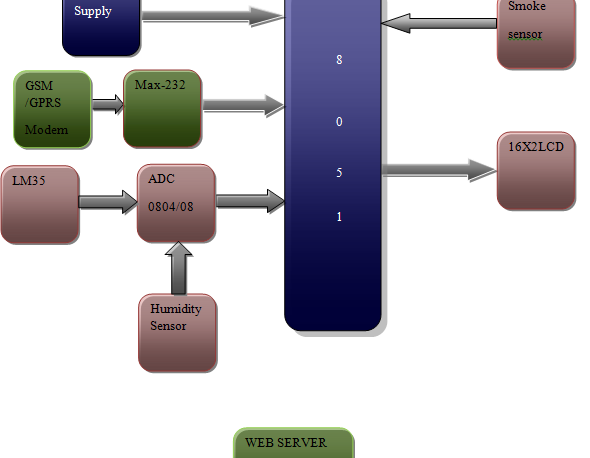
The system continuously measures weather conditions using multiple sensors connected to a microcontroller. The controller reads sensor values, processes the collected data, and displays the information locally if required. Through the GSM module, the system sends weather updates or alert messages to predefined mobile numbers whenever requested or when environmental values exceed preset limits. This allows users to monitor weather conditions remotely without visiting the installation site.
System Components
The project includes the following hardware components:
- Arduino Uno or PIC Microcontroller
- GSM Module (SIM800/SIM900)
- Temperature Sensor
- Humidity Sensor
- LDR Light Sensor
- Rain Sensor (Optional)
- LCD Display
- Power Supply
- Connecting Wires
- Antenna
Key Features
- Real-time weather monitoring
- GSM-based wireless communication
- Remote SMS notifications
- Accurate environmental sensing
- Low power consumption
- Easy installation
- Reliable long-distance monitoring
- Expandable with additional sensors
- Suitable for outdoor applications
Weather Data Transmission Process
The weather sensors continuously monitor environmental conditions. The microcontroller collects sensor readings and converts them into meaningful values. The GSM module then transmits the weather information to authorized users through SMS. Whenever abnormal weather conditions are detected, such as excessive temperature or humidity, the system automatically sends an alert message to ensure immediate action can be taken.
Advantages of GSM-Based Weather Monitoring
The project offers several benefits:
- Remote monitoring without internet
- Fast SMS-based alerts
- Reduced manual inspection
- Reliable communication
- Low maintenance
- Cost-effective implementation
- Improved environmental monitoring
- Supports smart agriculture
Applications
The Weather Monitoring System can be used in:
- Smart Agriculture
- Remote Farming
- Greenhouse Monitoring
- Weather Research Stations
- Forest Monitoring
- Industrial Sites
- Construction Areas
- Disaster Management
- Environmental Monitoring
- Educational Embedded Projects
Future Enhancements
The project can be upgraded using IoT cloud platforms, GPS location tracking, solar-powered operation, AI-based weather prediction, wireless sensor networks, and mobile applications for graphical weather analysis. Cloud integration can provide historical weather reports and real-time dashboards for advanced monitoring. Modern implementations also commonly combine GSM with cloud platforms for remote data logging and visualization.