Introduction
Continuous patient monitoring is an important requirement in hospitals and healthcare environments. Doctors and medical staff need timely information about vital parameters to observe a patient’s condition and respond when abnormal changes occur. A Hospital Patient Monitoring System through GPRS Communication combines sensors, a microcontroller, and wireless communication to collect and transmit patient-related information.
The system measures selected health and environmental parameters and sends the collected data to a remote monitoring platform using GPRS communication. This concept demonstrates how embedded systems and wireless technologies can support remote patient observation.
Purpose of the Monitoring System
The main objective of this project is to provide a method for monitoring important patient parameters without requiring medical staff to remain continuously near the patient’s bed.
Sensors connected to the embedded controller collect information at regular intervals. The controller processes these sensor readings and prepares them for local display and remote transmission.
Using GPRS communication allows the information to be transferred over a mobile network so that authorized personnel can access the monitoring data from another location.
System Architecture
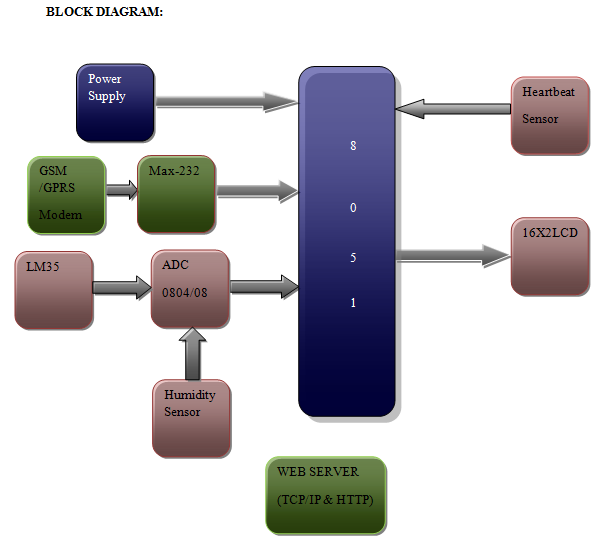
The patient monitoring unit consists of sensing devices, a processing controller, a display section, a communication module, and a regulated power supply.
The sensors continuously provide signals representing the parameters being monitored. The microcontroller processes these signals. The resulting values can be displayed locally and transmitted through the GPRS module.
The major sections of the system include:
- Microcontroller unit
- Temperature sensing unit
- Heartbeat sensing unit
- Humidity sensing unit
- GSM/GPRS communication module
- LCD display
- Regulated power supply
- Remote monitoring or server interface
Collection of Patient Parameters
Different sensors can be interfaced with the controller depending on the requirements of the monitoring application. In this project concept, temperature and heartbeat are among the important parameters used for observing the patient.
The sensor outputs are read periodically by the controller. The measured information is converted into a suitable digital representation so that it can be displayed and transmitted.
Environmental information such as humidity may also be included when monitoring the conditions surrounding the patient.
Role of the Microcontroller
The microcontroller acts as the central processing unit of the project. It coordinates communication between the sensors, display, and GPRS module.
After receiving sensor information, the controller performs the required processing and organizes the data into a suitable format. It can then update the LCD and initiate communication with the remote system.
The embedded program determines how frequently readings are collected and when information should be transmitted.
Local Parameter Display
An LCD can be incorporated into the system to provide immediate information near the patient’s location. The display allows hospital staff to observe the measured parameters without accessing the remote monitoring interface.
Displaying information locally is also useful during testing and system maintenance because it allows the operation of the sensors and controller to be verified.
GPRS-Based Data Transmission
General Packet Radio Service (GPRS) provides packet-based data communication over compatible cellular networks. In this project, a GSM/GPRS module provides the communication link between the embedded monitoring device and a remote server.
The controller communicates with the GSM/GPRS module using an appropriate serial communication interface. Once network connectivity is established, the measured patient information can be transmitted to the configured remote destination.
This approach enables monitoring over a wider geographical area compared with communication methods that depend only on short-range wireless connectivity.
Remote Monitoring Operation
After the patient information reaches the remote system, it can be stored and presented through an appropriate monitoring interface. Authorized medical personnel can then review the available readings without being physically present beside the monitoring device.
Remote availability of data can be useful when several monitoring units are deployed or when medical staff need access to information from different locations.
The actual implementation should include appropriate security and privacy controls whenever real patient information is transmitted or stored.
Sequence of System Operation
The monitoring process begins when power is supplied to the system. The controller initializes the connected sensors, display, and communication module.
The sensors then begin collecting the required parameters. The controller reads these values and updates the local display. After establishing communication with the GPRS network, selected readings are transmitted to the remote monitoring system.
This process can be repeated periodically according to the program configured in the microcontroller.
Importance of Wireless Connectivity
Wireless communication reduces the need for a dedicated physical data connection between the monitoring unit and the remote station. This provides greater flexibility when monitoring devices are installed in different areas.
GPRS-based communication is particularly useful as an educational project for understanding the integration of embedded electronics with cellular data communication.
Modern implementations may use newer cellular technologies depending on network availability, but the fundamental concept of sensing, processing, and remotely transmitting data remains similar.
Key Advantages
A GPRS-based patient monitoring project offers several technical advantages:
- Remote transmission of monitored parameters
- Continuous or periodic sensor data collection
- Local display of measured information
- Reduced dependence on wired communication
- Integration of sensors with embedded controllers
- Demonstration of GSM/GPRS networking concepts
- Ability to maintain historical readings on a server
- Scope for adding additional sensing parameters
Possible Applications
This type of embedded monitoring concept can be studied for applications such as hospital monitoring systems, healthcare research projects, remote medical observation prototypes, elderly-care monitoring concepts, and wireless biomedical instrumentation.
It is also useful as an academic embedded-system project because it combines sensor interfacing, microcontroller programming, serial communication, cellular networking, and server-side data handling.
Future Development Possibilities
The basic system can be expanded by incorporating additional sensing and communication technologies. Depending on the intended application, future versions may include oxygen saturation sensing, additional temperature monitoring, mobile applications, cloud-based dashboards, automatic notifications, and data logging.
Modern cellular modules supporting LTE, NB-IoT, or other available network technologies may also replace older GPRS modules.
For real clinical use, however, additional requirements such as medical-device validation, measurement accuracy, cybersecurity, reliability, patient privacy, and applicable regulatory standards must be addressed.
Conclusion
The Hospital Patient Monitoring System through GPRS Communication demonstrates how embedded technology can be used to collect patient-related parameters and make the information available remotely. Sensors acquire the required measurements, while the microcontroller processes the information and controls the display and communication functions.
By integrating GPRS connectivity, the system demonstrates remote data transmission over a cellular network. The project provides a useful platform for learning about sensor interfacing, embedded programming, wireless communication, and remote monitoring while also providing opportunities for further development using modern IoT and cellular technologies.
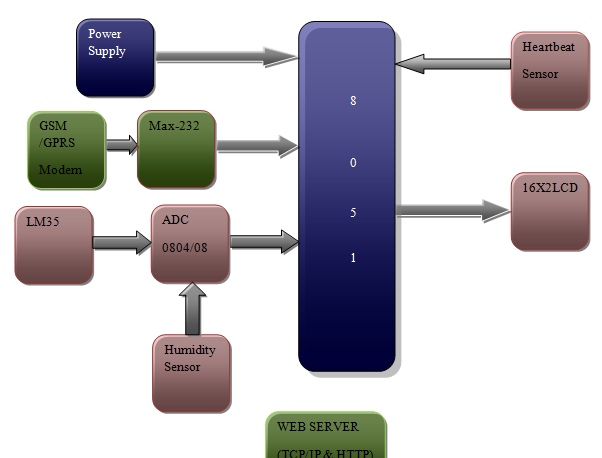
BLOCK DIAGRAM