Abstract :
Nowadays, many real-time embedded applications are connected to the internet, allowing users to access information from anywhere in the world. These applications follow the client-server architecture, where communication between the embedded device and the web server is established using TCP/IP and HTTP protocols. Data is transmitted wirelessly through GPRS (General Packet Radio Service), enabling reliable and secure transfer of attendance records to a centralized web server. GPRS communication supports the transmission of large amounts of data, making it suitable for various embedded networking and IoT applications.
In many schools, colleges, universities, offices, and industries, attendance is still maintained manually using paper registers or signature sheets. This traditional method is time-consuming, prone to human errors, and susceptible to unauthorized modifications. To overcome these limitations, this project introduces an automated Student/Employee Attendance System that records attendance electronically and updates the information to a remote web server in real time.
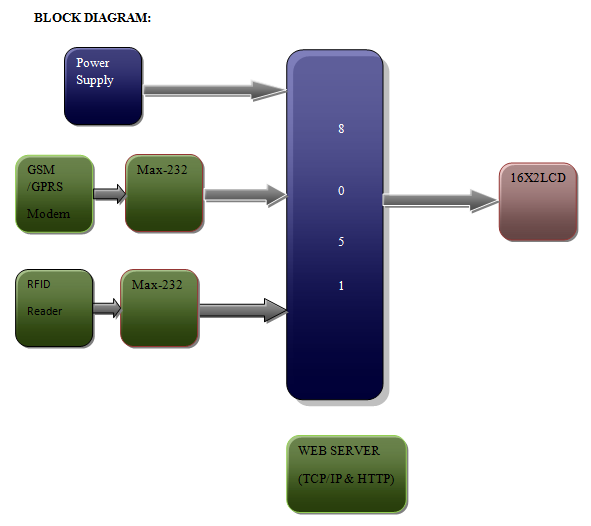
The system supports multiple identification technologies, including RFID cards, Smart Cards, Magnetic Stripe Cards, Fingerprint Sensors, and other authentication methods based on customer requirements. Whenever a student or employee enters the premises, they simply present their identification card or biometric credential to the reader. The reader captures the user ID and sends it to the 8051 microcontroller for verification.
The microcontroller compares the received ID with the stored database. If the authentication is successful, the attendance record, including the user ID, date, and time, is processed and transmitted to the web server using a GSM/GPRS modem through TCP/IP and HTTP protocols. If an invalid or unauthorized ID is detected, the system activates a buzzer to generate an alert and simultaneously displays an error message on the 16×2 LCD display.
The GSM/GPRS modem communicates with the microcontroller through the UART (Serial Communication) interface and operates using standard AT commands. The attendance data is sent to a web server configured with a static IP address and a designated port number, where all records are securely stored in a centralized database. Administrators can access attendance information, generate reports, and monitor employee or student attendance remotely through the web application from anywhere in the world.
The hardware is built around an 8051 microcontroller powered by a regulated 5V DC power supply. A 16×2 LCD display is connected through the digital I/O pins to display system messages and attendance status. The GSM/GPRS modem provides wireless internet connectivity, enabling real-time synchronization of attendance data with the web server.
This automated attendance system improves accuracy, eliminates manual paperwork, prevents attendance manipulation, and provides secure, real-time attendance management for educational institutions, offices, factories, and industrial organizations.
TECHNICAL SPECIFICATIONS:
HARDWARE SPECIFICATIONS
Microcontroller : AT89x series
Crystal : 11.0592 MHz
LCD : HD44780
LED : 5 mm Red LED
Modem of choice : RFID/Barcode/Magnetic stripe
Basic GPIOs
GSM/GPRS modem : Sim300/ Sim 900
RS232 interface : ST/MAX: 232
POWER SUPPLY
Transformer : 12V step down
Filter : 1000uf/25V
Voltage Regulator : 7805 / 7812
SOFTWARE SPECIFICATIONS
Software tools used
Keil IDE
Proteus VSM
UC flash
Web server
APPLICATIONS
- Attendance systems
- Authentication systems
- Security systems
BLOCK DIAGRAM