Design Objectives
The primary objective of the FingerPrint – Based Security System is to develop a reliable biometric authentication solution capable of identifying authorized users with high accuracy. The project replaces traditional keys and passwords with fingerprint recognition, improving security while reducing the risk of unauthorized access.
Operating Principle
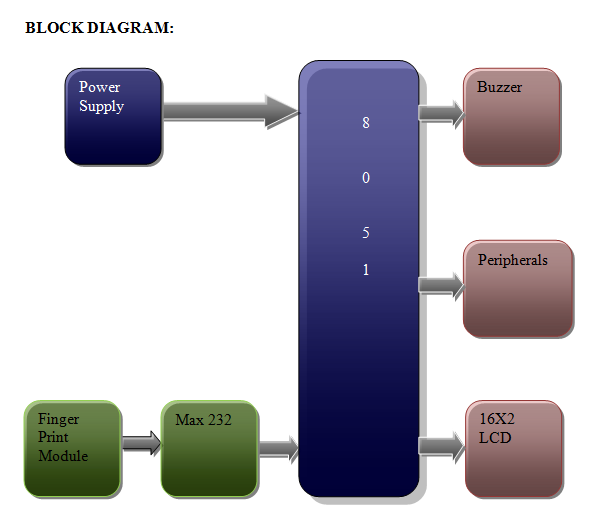
The system begins by waiting for a registered user to place a finger on the biometric sensor. The fingerprint module scans the fingerprint pattern and converts it into a digital template. This template is compared with all previously enrolled templates stored in the sensor memory. If a successful match is found, the microcontroller activates the relay to unlock the door or enable the connected device. If the fingerprint is not recognized, access is denied, and the warning buzzer is activated.
Hardware Configuration
The project includes the following embedded hardware modules:
- AT89S52 Microcontroller
- Optical Fingerprint Sensor
- 16×2 LCD Display
- 5V Relay Module
- Electromagnetic Door Lock
- Piezo Buzzer
- Status LEDs
- Crystal Oscillator
- Reset Circuit
- Regulated Power Supply
Each component is selected to ensure stable operation, low power consumption, and reliable biometric verification.
Electrical Specifications
| Parameter | Value |
|---|---|
| Input Supply | 230V AC |
| Output Supply | 5V DC |
| Controller Clock | 11.0592 MHz |
| Display Type | 16×2 LCD |
| Fingerprint Module | Optical Sensor |
| Communication | UART TTL |
| Relay Voltage | 5V |
| Programming Language | Embedded C |
| Development IDE | Keil uVision |
| PCB Type | Single Layer PCB |
Authentication Cycle
The authentication process consists of multiple stages:
- System initialization
- Finger placement detection
- Image acquisition
- Fingerprint template generation
- Template matching
- User verification
- Door unlocking
- Access logging
- System reset
The complete verification process typically takes only a few seconds.
Performance Highlights
The FingerPrint -Based Security System offers several practical benefits:
- Fast response time
- High matching accuracy
- Low maintenance requirements
- Secure biometric authentication
- Easy hardware integration
- Expandable user database
- Stable embedded performance
- Simple installation
Industrial Applications
Fingerprint authentication technology is widely implemented in:
- Manufacturing industries
- Smart office buildings
- Banking institutions
- Hospital security systems
- Government organizations
- Warehouse management
- Pharmaceutical industries
- Data centers
- Residential apartment security
- Educational campuses
Project Enhancement Opportunities
The current system can be extended with several advanced technologies:
- Wi-Fi connectivity
- Cloud-based user database
- Face recognition support
- Mobile application monitoring
- OTP verification
- Remote access management
- Attendance reporting
- Visitor management
- AI-based anomaly detection
- Voice notification system
Engineering Benefits
This project helps engineering students understand the practical implementation of biometric systems, serial communication, embedded programming, relay interfacing, LCD programming, and secure access control. It also introduces students to real-world embedded applications used in commercial security products.
Project Summary
The FingerPrint- Based Security System demonstrates how embedded technology and biometric authentication can work together to provide dependable access control. The project emphasizes accurate user verification, efficient hardware integration, and dependable system performance. Its modular architecture allows future expansion with wireless communication, cloud services, and advanced biometric technologies, making it a valuable reference project for embedded systems development and industrial automation.
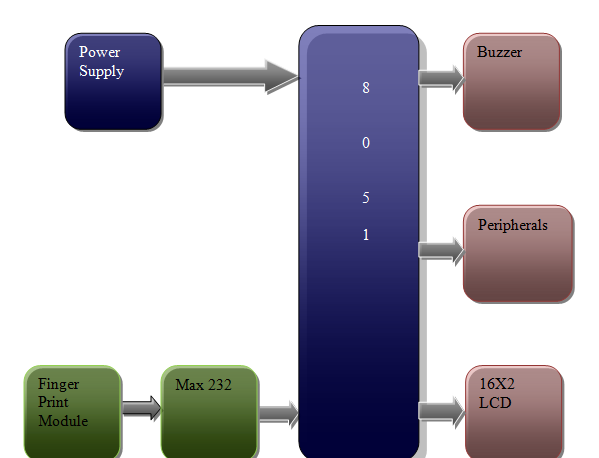
BLOCK DIAGRAM :