Introduction
The Fingerprint Recognized ATM System is an advanced embedded systems project that enhances ATM security using biometric fingerprint authentication. Unlike conventional ATM systems that depend only on an ATM card and PIN, this system verifies the user’s fingerprint before allowing access to banking services. Since fingerprints are unique to every individual, biometric authentication significantly improves security and minimizes unauthorized access, card theft, and fraudulent transactions.
This project demonstrates the integration of embedded systems, biometric technology, and banking security. It is an excellent project for engineering students, researchers, and developers interested in embedded systems, automation, and secure authentication.
Project Overview
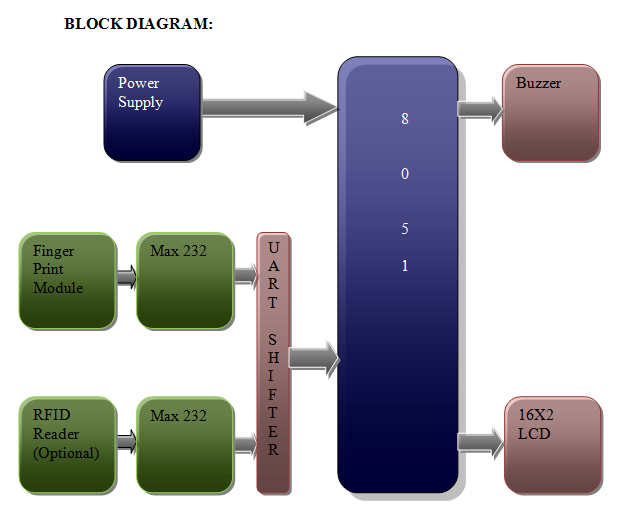
The system consists of a fingerprint sensor, microcontroller, LCD display, keypad, buzzer, and power supply. During registration, the customer’s fingerprint template is stored securely in the fingerprint module. Whenever a customer wants to perform a transaction, their fingerprint is scanned and compared with the stored database.
If the fingerprint matches, the customer is authenticated and prompted to enter the PIN. Once both authentication stages are successfully completed, the ATM functions such as cash withdrawal, balance enquiry, mini statement, and fund transfer become available.
This dual-layer authentication provides a much higher level of security than traditional ATM systems.
Technical Specifications
| Specification | Details |
|---|---|
| Project Name | Fingerprint Recognized ATM System |
| Project Category | Embedded Systems Project |
| Technology | Biometric Authentication |
| Controller | ATmega328P / PIC16F877A / ARM Cortex |
| Fingerprint Sensor | R305 / R307 Optical Fingerprint Sensor |
| Display | 16×2 LCD Display |
| Input Device | 4×4 Matrix Keypad |
| Communication Protocol | UART Serial Communication |
| Operating Voltage | 5V DC |
| Input Power | 230V AC to 5V DC |
| Programming Language | Embedded C |
| Development Software | Keil uVision / MPLAB X / Arduino IDE |
| PCB Design Software | Altium Designer |
| Simulation Software | Proteus Professional |
| Memory | EEPROM / Flash Memory |
| Authentication | Fingerprint + PIN |
| Response Time | Less than 2 Seconds |
| Fingerprint Storage | Up to 1000 Users (Sensor Dependent) |
| Operating Temperature | 0°C to 50°C |
| PCB Type | Single Layer / Double Layer |
Hardware Components
- Fingerprint Sensor Module
- Microcontroller
- LCD Display
- Matrix Keypad
- Regulated Power Supply
- Crystal Oscillator
- EEPROM Memory
- Buzzer
- LEDs
- Push Buttons
- Voltage Regulator
- PCB
- Resistors and Capacitors
Software Requirements
- Embedded C Programming
- Keil uVision IDE
- MPLAB X IDE
- Arduino IDE
- Proteus Professional
- Altium Designer
- USBasp / PICkit Programmer
Working Principle
The customer first places a finger on the optical fingerprint sensor. The sensor captures the fingerprint image and extracts unique biometric characteristics. These characteristics are compared with the fingerprints stored in the sensor’s memory.
If the fingerprint matches an authorized user, the system requests the user’s PIN for additional verification. After successful authentication, the microcontroller grants access to ATM functions. The LCD displays transaction options, while the keypad allows the customer to choose banking operations.
If authentication fails, the system denies access and activates the buzzer to indicate an invalid attempt.
Features
- Biometric fingerprint authentication
- Dual-layer security using fingerprint and PIN
- Fast fingerprint recognition
- High authentication accuracy
- Secure embedded system architecture
- LCD-based user interface
- Low power consumption
- Compact PCB design
- Easy operation and maintenance
- Expandable fingerprint database
Applications
- Banking ATM Security
- Financial Institutions
- Smart Banking Systems
- Biometric Access Control
- Secure Payment Terminals
- Government Banking Services
- Digital Banking Solutions
- Identity Verification Systems
- Office Security Systems
- Educational Research Projects
Advantages
- Eliminates card duplication risks
- Prevents unauthorized ATM access
- Reduces banking fraud
- Provides reliable biometric verification
- Faster customer authentication
- User-friendly interface
- Low maintenance cost
- High system reliability
- Enhanced customer security
- Scalable for future upgrades
Performance Specifications
- High-speed fingerprint matching
- Low false acceptance rate
- Low false rejection rate
- Stable UART communication
- Reliable embedded firmware
- Efficient memory management
- Continuous operation capability
- Low power consumption
- High authentication accuracy
- Secure transaction processing
Project Deliverables
- Complete Circuit Diagram
- PCB Layout Design
- Gerber Files
- Bill of Materials (BOM)
- Embedded C Source Code
- HEX File
- Project Documentation
- User Manual
- Installation Guide
- Testing Report
- Presentation (PPT)
- Demo Support
Future Scope
The project can be enhanced by integrating advanced technologies such as:
- Face Recognition
- Iris Recognition
- OTP-Based Verification
- Aadhaar Authentication
- Cloud Database Integration
- AI-Based Fraud Detection
- Mobile Banking Integration
- IoT-Based ATM Monitoring
- GSM Alert System
- Real-Time Transaction Notifications
Conclusion
The Fingerprint Recognized ATM System is a secure and reliable embedded systems project that combines biometric fingerprint authentication with traditional PIN verification to enhance ATM security. It demonstrates the practical implementation of embedded controllers, fingerprint sensors, and secure authentication techniques for modern banking applications.
This project is suitable for engineering students, academic institutions, research organizations, and developers working on embedded systems, banking security, and biometric authentication. It provides hands-on experience in hardware design, embedded programming, PCB development, and secure access control systems.
BLOCK DIAGRAM :